Expert Opinion: an Interview with Alejandro Reyes of the Lawyers’ Committee for Civil Rights Under Law

[Editor’s note: “Expert Opinion” is a weekly feature which offers insight , opinion, and career advice from attorneys in a broad array of public interest positions.  This week’s post is an interview with Alejandro Reyes that was conducted by PSJD’s Summer Publications Coordinator, Maria Hibbard.  In the interest of full disclosure, Alejandro has bought your PSJD blog editor some great Thai lunches over the years.  Next one’s on me.  Thanks for sharing your experience and wisdom, Alejandro!] 

An Interview with Alejandro Reyes….

Alejandro Reyes is counsel at the Laywers’ Committee for Civil Rights Under Law in Washington, D.C., where as a member of the Legal Mobilization Project he works on civil rights issues related to fair housing, voting, and immigrant rights. After hearing him speak on a panel at the Washington Council of Lawyers’ annual Summer Forum, I sat down to talk with him more about his path to becoming a public interest lawyer.  After graduating from the Howard University School of Law, he went on to complete an Equal Justice Works fellowship with Gulfcoast Legal Services and then worked as an attorney with Florida Legal Services.

**********

Can you give us a brief outline of how you advanced to the job you are in today? Was this position what you originally planned on doing, or was your career trajectory part of an evolving process?

No career is a straight line–although I started law school wanting to be a public interest lawyer, and specifically an immigration lawyer. I was teaching ESL classes in D.C., and one of the main problems that I saw among the individuals I worked with was that they were paying huge sums of money to firms to solve their immigration issues, even when they didn’t have cases. That’s when I started thinking about going to law school and getting more serious about the process. In law school, I did two summer internships that were immigration related and one civil rights policy internship, and they really solidified my interests. When I was getting close to graduating law school, I was pretty sure I wanted to pursue a fellowship–specifically an Equal Justice Works fellowship–and I started talking to my internship host at the time (Gulfcoast Legal Services) about the possibility of being a fellowship sponsor.

How did your contacts with previous employers, professors, and colleagues influence your job search, if any?

Talking to my supervisor at Gulfcoast Legal Services and others that I met through the organization helped define what my fellowship project would look like. Even though they had just secured another immigration-focused Equal Justice Works fellow and didn’t think they could sponsor another one, I was eventually introduced to the idea of doing a fellowship proposal based on farm worker and migrant rights.  Even though it was not what I was originally focused on, it was related, and it allowed me to do a fellowship at an organization where I wanted to be.

Generally, if you try hard enough, and you care about your work, you will succeed in public interest. The most important part, though, is to have advocates who have seen your work product, who care about you, and want you to succeed. Someone once told me to “walk away with powerful advocates” at every chance you get–so you need to find ways to have meaningful, continuing contact with your previous supervisors, professors or colleagues. Since the public interest law world is so small, you can’t do it alone–you need the support of others.

What experiences or internships did you complete in law school that helped prepare you for your work today?

Although I came to law school knowing what I wanted to do, I was inspired by studying the work of Thurgood Marshall and Charles Hamilton Houston in school. My internships in law school during both the summer and the school year shaped me more than anything else, though–there I was able to really see the work that I wanted to do in action and develop relationships. Going to law school, passing the bar, etc. were just requirements that were part of the path for me. 

If I had the chance to go back, I wish I would have known how important it is to build quality professional relationships

Would you change your preparation for this position in any way if you had the chance?

If I had the chance to go back, I wish I would have known how important it is to build quality professional relationships. The advantage of reaching out to someone who works in an area in which you want to work is that they’ve done this before, and they therefore have years of experience in the area, so that they know how things work.

I also wish I would have better understood how legal services funding works. Where the funding is coming from, and how much is there, can really affect your ability to do your job–determine if your job even exists. Because of this funding uncertainty, there really is a lack of job security that is not there in private practice or in the federal government. You have to have very good reasons for going into this type of work–otherwise, there’s too many unknowns.

What advice would you offer to law students seeking a position in your area of practice?

There’s many schools of thought on this: the first says that you should develop a practice-specific resume, focusing intensely on one area so that you are the clearly the best candidate for a job. The second says that you should diversify and gain a wide variety of experiences. I’ve seen that a person who diversifies has to be a lot better at articulating a compelling story as to their motivations and goals, especially in interviews–otherwise, the individual who has focused on one area may come across as the better candidate.

 [Ed. note: Alejandro mentions the importance of professional networking as well as the value that his Equal Justice Works fellowship had in helping him carve out a career path.  Don’t miss PSJD’s resources on professional networking and postgraduate fellowships.  And email us at psjd@nalp.org with suggestions on how we can be most helpful to you.]

Comments off

Job(s) o’ the Day: Legal Interns for the National Housing Law Project in San Francisco!

The National Housing Law Project is looking for Spring and Summer 2013 interns!

In the past, spring intern projects have included preparing congressional testimony, preparing extensive research memos on state and local housing laws, and drafting amendments to federal housing legislation. Summer work projects typically include drafting amicus briefs, researching the impact of proposed housing legislation and regulations, drafting portions of advocacy guides used by housing advocates across the country, and writing articles for NHLP’s monthly Housing Law Bulletin.

The National Housing Law Project has successfully sponsored several student interns for post-graduate fellowships, so this is a great way to get your foot in the door while gaining much-needed experience!

 Check out the full listings on PSJD by selecting “Current Job Postings” on the National Housing Law Project’s employer profile (log-in required)!.


Comments off

Making the Most Out of Your ‘Favorites’ on PSJD

by: Ashley Matthews

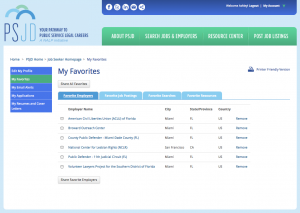
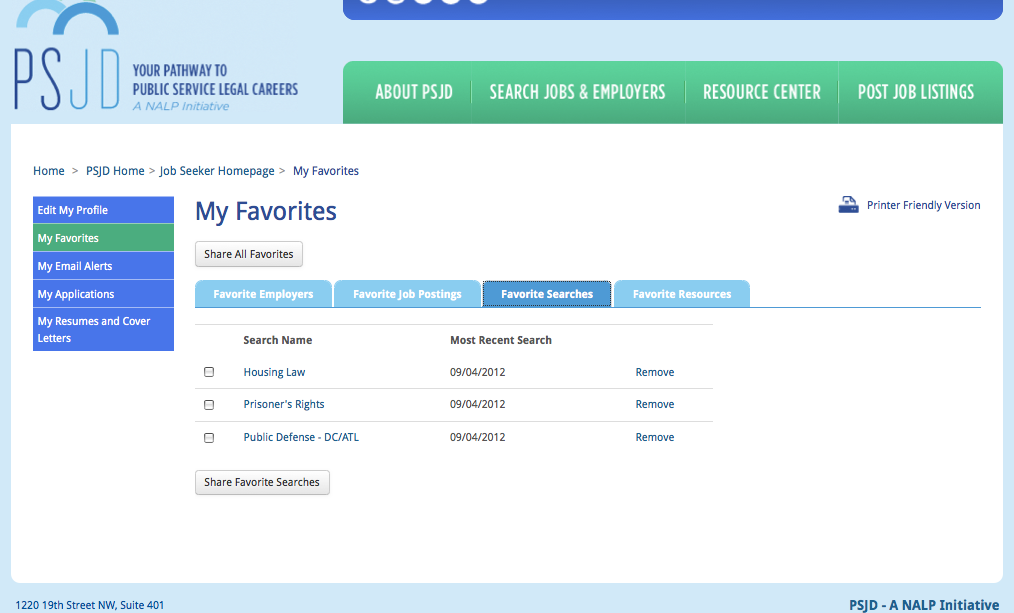
Note: Click on the screenshot for a larger view.

During the job hunt, promising opportunities can easily get lost in the sea of available job openings. PSJD.org lets you to keep tabs – literally – on favorite finds during your job search, so you can access them at any time.

Your Favorites can be found on your personal homepage, under the heading “My Account”.

Just click on “My Favorites” to see your job listings, dream employers, saved searches, and most helpful resources.

If you see an employer that stands out among your search results, simply click the plus sign under the “Favorite” column. The color will change from gray to green, and it will immediately appear under “Favorite Employers”. If that employer has current job openings, there will be a green star next to the name of the organization.

To favorite that job as well, just click the plus sign under the “Favorite” column.

To add searches to your Favorites, click “Save this Search,” located above your results. A dialogue box will appear, with a request to create a Search Title.

After creating an easily recognizable name, this search can be found at any time under “Favorite Searches”.

PSJD.org’s Resource Center is a great place to look for information to aid your public interest job search. Divided into six categories for easy browsing, the library contains calendars, fellowship guides, information on funding opportunities, and more.

Let’s say you find “Project-based Fellowships: Tips From Those Who Know” to be particularly helpful while browsing the library. Just click the small gray banner symbol above the title, located directly next to “Printer Friendly Version”.

When you go to your Favorites page, the resource will be listed under “Favorite Resources”.

With all this information at your fingertips on your ‘My Favorites’ page, it would be a good idea to compile your favorites into a Jobs Spreadsheet. Check out this spreadsheet, created by last year’s PSJD Fellow Kristen Pavón, for guidance on keeping track of your job search using Microsoft Excel. Don’t forget to also set up email alerts to automatically keep track of job openings that may interest you.

Happy job hunting!

Comments off

New Resource: PSJD’s Federal Legal Employment Opportunities Guide (2012-13)

Hot off the presses is our 2012-13 Federal Legal Employment Opportunities Guide!  (It goes by the unfortunate acronym FLEOG; that’s why we tend to write it all out.)  The Guide offers a broad-based review of different career opportunities and paths to employment for law students and graduates who are interested in federal legal careers.  The Guide is a distillation of the key content from PSJD’s more extensive Federal Govenment Careers page.  We hope you find both the guide and online content useful. 


Comments off

Pro Bono Award Nomination Deadline Extended! (Until Friday, 9/14)

Hello, readers.  We know it’s a busy time of year. So we’re extending the nomination deadline for our 2012 PSJD (formerly PSLawNet) Pro Bono Publico Award by one week.  The new deadline is Friday, 9/14.  Take advantage of this opportunity to shine the spotlight on a law student who deserves national recognition for her public interest and pro bono work.  Here’s what you need to know:

Do you know a law student who’s a public interest/pro bono rock star?  NALP is seeking nominations for the 2012 PSLawNet/PSJD Pro Bono Publico Award. 

Download the Nomination Form Here!

Purpose: To recognize the significant contributions that law students make to underserved populations, the public interest community, and legal education by performing pro bono or public service work.

Eligibility: The Pro Bono Publico Award is available to any second- or third-year law student at a PSJD Subscriber School. The recipient will be honored during an Award Luncheon at NALP’s Public Service Mini-Conference on Thursday, October 25, 2012 at the Washington, DC office of Crowell & Moring, LLP. The award recipient will receive transportation to Washington, a one-night stay in an area hotel, a commemorative plaque, and a small monetary award.

Award Criteria: Law students are judged by the extracurricular commitment they have made to law-related public service projects or organizations; the quality of work they performed; and the impact of their work on the community, their fellow students, and the school. Though a student’s involvement in law school-based public interest organizing and fundraising is relevant; actual pro bono and public interest legal work will be the primary consideration. 

Nomination Deadline & Packet Contents: Nominations must be received by Friday, September 7, 2012 at 5pm Eastern Time, by fax, mail, or email (see contact information at bottom). Along with the nomination form and a résumé, nomination packets may include any materials which support a nominee’s candidacy; such as letters of recommendation, statements detailing a nominee’s work, and media articles. 

Comments off

New Resource: “An Employer and Employee Guide to Public Service Loan Forgiveness”

By: Steve Grumm

The ABA’s An Employer and Employee Guide to Public Service Loan Forgiveness, authored by student-debt experts (and public interest lawyers) Kelly Carmody and Heather Jarvis,  is now available.  The Guide contains the information needed to help public service attorneys and other employees with high educational debt take the steps to have their debt forgiven after ten years as a public service worker. Executive Directors  and HR staff are encouraged to take the steps listed on the first page of the Guide.  Those with high educational debt are encouraged to review the Guide and use the tools to put their federal loans in a position to be forgiven.

Comments off

Job o’ the Day: Staff Attorney with the Central American Resource Center in DC!

The Central American Resource Center (CARECEN) in Washington, DC is seeking an immigration law attorney to provide direct legal assistance, public education, and pro bono recruitment.

With an emphasis on community service and economic development, CARECEN was established in 1981 to protect the rights of refugees in Central America. CARECEN attorneys provide direct legal representation to facilitate the immigration process, in addition to assistance with housing and civil rights. All CARECEN programs are available to low and moderate income Latinos in the Washington Metropolitan area.

CARECEN prefers applicants who are fluent in Spanish with 2-3 years experience with immigration law or immigrant rights. Applicants should have excellent written and verbal communication skills, and a demonstrated commitment to social justice.

For more information on this position, view the full listing at PSJD.org (log-in required).

Comments off

DOJ Application Deadlines Today: Honors Program and Summer Law Intern Program (SLIP)

By: Steve Grumm

Two important Department of Justice application deadlines are today:

  • The Attorney General’s Honors Program: the Attorney General’s Honors Program is Justice’s competitive, centralized recruitment program that is the only way for new attorneys (i.e., third-year law students and students who enter judicial clerkships, graduate law programs, or qualifying fellowships within 9 months of law school graduation) to enter Justice in an attorney position.
  • The Summer Law Intern Program (SLIP) – law students who have completed at least one full semester of legal study by the application deadline are eligible to apply. Most successful applicants intern the summer between their second and third year of law school; however, graduating law students who will enter a judicial clerkship or a full-time graduate law program may intern following graduation.  Part-time law students are also eligible to apply. All applicants should review eligibility rules. 

Comments off

Job o’ the Day: 2013 Summer Intern with the Southern Poverty Law Center!

Happy Labor Day, folks!

Today’s job of the day is awesome because it is a PAID opportunity! That’s right – the Southern Poverty Law Center (SPLC) is looking for summer interns to work for $700 a week in its Montgomery, Alabama office.

The SPLC invites applicants in their second year of law school who possess strong academic backgrounds, excellent research and writing skills, and a commitment to public interest law. A minimum of ten weeks is required, and students will work mainly on issues affecting children, prisoners, the LGBT community, and economically disadvantaged communities.

View the full listing at PSJD.org (log-in required)!

Comments off

Job o’ the Day: Policy Advocate with the Center for Medicare Advocacy in DC!

The Center for Medicare Advocacy in Washington, DC is looking for a Policy Advocate to provide writing, analysis and advocacy regarding access to health care, due process, and other related issues for Medicaid and Medicare beneficiaries. The Policy Advocate will also be actively involved with the Center’s legal research, analysis, writing and educational activities and will serve as the liaison for the organization’s Medicare Maximization work. In addition to leading the Center’s policy and communication efforts, the Policy Advocate will also assist with federal litigation and community education.

The Center prefers to hire a Police Advocate with a law degree, Master’s in Public Health, or an equivalent degree with at least 5 years of experience. For more information, view the full listing at PSJD.org (log-in required).

Comments off