
Voting Rights Act Snafu: Texas Citizens Removed from Voter Registration Rolls for Being Dead, Although They are Still Living

by Ashley Matthews

In the midst of a national debate over the enforcement of the Voting Rights Act, Texas has shaken things up once again with its latest effort to revise the state’s voting procedures. This time, more than a few Texas citizens were shocked to find out they couldn’t vote – because they had been declared dead. Seeing as how they were still alive, this presented a major problem.

From Bloomberg Businessweek:

Texas officials were temporarily barred by a state judge from ordering county election officials to purge presumably dead voters from registration rolls because the initiative may violate the election code.

The ruling came in a lawsuit filed yesterday by four voters who were told they would be purged from voter-registration lists as deceased. They asked state court Judge Tim Sulak in Austin to stop the state from striking about 77,000 names, arguing the plan violates state and federal law.

The secretary of state is “restrained from further instructing the counties to remove any other names from the voter rolls,” Sulak said in an order. “Plaintiffs are entitled to temporary injunctive relief.”

The voters’ Lawyers say that under the federal Voting Rights Act the state must get pre-approval for the rule changes. The law mandates that jurisdictions with a history of rights violations first get clearance for new election procedures from the U.S. Justice Department or a three-judge panel.

“There is no statutory authority for this purge,” David Richards, a civil rights lawyer who represents the plaintiffs, said in a phone interview while waiting for the judge to rule.

Texas recently lost a federal court of appeals case striking down the state’s voter identification law passed by the Texas Legislature last year. This lawsuit is only one of multiple court battles being fought over voting rules in swing states like Florida, Pennsylvania, and Wisconsin.

Comments off

Public Interest News Bulletin – September 21, 2012

By: Steve Grumm

Hi, folks.  There is much news to cover in the access-to-justice, pro bono, and public interest arenas – including, of course, information about New York State’s newly implemented rule requiring 50 hours of pro bono service before getting licensed to practice.  Before that, a few other items that caught my attention this week: 

Okay, the public interest news in very brief:

  • more legal aid funding from the national mortgage foreclosure fraud class-action settlement (MA and RI):
  • Missouri public defenders about to implement new policies to limit caseloads;
  • the legal aid community should use more research and data to make progress on the access-to-justice front;
  • a new veterans initiative from 2 Florida legal services providers;
  • an update on San Fran’s Neighborhood Prosecutor Initiative;
  • details on NY’s new 50-hour pro bono requirement for admission to the bar;
  • light on lawyers to help the poor in NW Texas;
  • Contra Costa County prosecutors headed for the picket lines(?);
  • rolling out the Ohio Veterans and Military Legal Assistance Project;
  • trouble in Warren County, NY meeting new state indigent defense standards;
  • educating nonprofit funders about legal aid’s importance;
  • LSC has a new VP for grants management;
  • call for proposals for the Equal Justice Conference’s law school pro bono pre-conference;
  • more self-help legal centers in Illinois (keeping w/ a national trend);
  • NorCal pro bono all-stars;
  • public defenders should not post pictures of clients’ underwear (leopard-skin or otherwise) on the Facebooks;
  • Harvard, Stanford, NYU, and Yale law schools get Ford Foundation funding to promote student public interest work;
  • Super music bonus!

The summaries:

  • 9.20.12 – some good legal-aid funding news out of New England, stemming from the national foreclosure fraud class-action settlement:
    • Rhode Island: “To assist low and middle income families facing foreclosure, Attorney General Peter Kilmartin today announced a two-year, $1.57 million grant to Rhode Island Legal Services (RILS) to fund the Foreclosure Prevention Project.  The Foreclosure Prevention Project grant is funded through the National Mortgage Settlement between the five largest mortgage service providers and attorneys general nationwide…. With the grant, RILS expects to help stop, prevent, or delay the foreclosure of approximately 1,800 homes each year.”  (Full article on LoanSafe website.) 
    • Massachusetts: “The Massachusetts Legal Assistance Corporation (MLAC) and the National Consumer Law Center (NCLC) are set to launch a two-year effort to give legal help to homeowners facing foreclosure or eviction.  The Borrower Representation Initiative is being funded by a $6 million grant from the Massachusetts Attorney General’s office.”  (Story from the Boston Business Journal.  And here’s more info from AG’s website.


  • 9.20.12 – Missouri public defenders are about to implement new policies regarding caseload restrictions in order to alleviate pressures and increase quality of service to defendants.  Here is an interview with Cat Kelly, head of the statewide indigent defense program.  An excerpt of Ms. Kelly explaining forthcoming changes: “As of October, 17 district public defender offices serving 54 counties will be operating on limited availability — meaning they will be able to take cases during that month only up to their maximum allowable monthly caseload and then their doors will have to close.  Any remaining applications will have to go on a waiting list for defender services unless the judges choose to do something else with them — e.g. dispose of the cases without jail time (since the possibility of jail time is the constitutional trigger that requires appointment of counsel) or appointing private attorneys to handle the cases pro bono (without pay).  Another 10-12 offices are in line to do the same in the next month or two.  All but three public defender trial offices are significantly overloaded and those three (Moberly, Maryville, and Kirksville) are operating right at or just slightly over their capacity.” More coverage: 
    • 9.20.12 – a story from TV station KY3: The Missouri State Public Defenders office is bursting at the seams. It’s a problem that’s been brewing since the early 1990s.  Caseloads keep growing but staffing increases are not keeping up.   In 2008, the Public Defender Commission decided enough was enough.  It limited the number of cases each district could take as a way to deal with the growing overload.   The commission’s ability to impose such caps was tied up in litigation.  That changed in last July.  That’s when the Missouri Supreme Court decided judges cannot appoint public defenders to additional cases after they’ve reached their
    • 9.13.12 – “Boone and Callaway County attorneys who practice civil law found out yesterday they might be assigned criminal defense cases as soon as next month as the result of a new cap local public defenders are placing on their caseloads…. Thirteenth Judicial Circuit Presiding Judge Gary Oxenhandler [went on to say,] ‘Don’t think for a moment that somehow this crisis is the fault of the public defender. It is not. For the past 40 years, the public defender has been the savior of the private bar.”  (Story from the Columbia Tribune.)   


  • 9.20.12 – the Pro Bono Institute’s Esther Lardent calls for increased use of statistical- and research-based processes in evaluating access-to-justice needs in the civil legal services community.  “All too often in the civil legal services and pro bono worlds we simply rely on our sense of what works and anecdotal information, rather than rigorous and evidence-based research on what strategies, fora, and approaches work best for which low-income clients. With so many low-income families facing foreclosure, can we identify with any degree of confidence and evidence of outcomes, which approaches – mediation, litigation, negotiation – work best for which types of homeowners? As the number of bankruptcies grows, have we analyzed the outcomes of these cases to identify the most effective steps and protocols? At a time when more and more people come to court without a lawyer, have we examined the different models of pro se/self-representation and their usefulness for various matters such as landlord/tenant versus small claims?  Sadly, the answer is that, with some notable exceptions, we have not.”   Here’s Lardent’s full piece.
  • 9.20.12 – in Florida, the Legal Aid Service of Broward County and Coast to Coast Legal Aid of South Florida are collaborating on a goal “to create a veterans’ initiative, expanding upon current services provided to military members and their families. Expanded services include representation in securing veterans’ benefits and Social Security benefits for homeless veterans, and obtaining driver’s licenses and birth certificates. The initiative will assist in eviction and foreclosure prevention; family issues such as child support, custody and divorce, and probate and consumer matters.”  (Full op-ed in the Sun-Sentinel.)
  • 9.20.12 – in San Francisco, “District Attorney George Gascón updated reporters Wednesday morning on his office’s 18-month old Neighborhood Prosecutor Initiative and announced his plan for a program for juvenile offenders throughout the city.  The initiative aims at curbing recidivism and keeping non-violent crimes such as infractions out of the criminal court system.  There are currently nine neighborhood courts, each with prosecutor assigned to work with two police districts.”  The initiative uses volunteer “adjudicators” who work with prosecutors to determine criminal punishment and treatment options that will help defendants avoid future criminal activity.  (Story from the MissionLocal website.)


  • 9.19.12 – Details of the new 50-hour pro bono requirement for applicants to the New York bar were unveiled yesterday by Chief Judge Jonathan Lippman…. The first-in-the-nation requirement will take effect immediately for first- and second-year law students, who will have up to 34 months to fulfill the mandate. Current third-years are exempt.  Starting Jan. 1, 2015, every applicant to the bar will be required to fulfill the requirement….  Approved pro bono work includes legal services for people of “limited means”; not-for-profit organizations; individuals or groups seeking to promote access to justice; and public service in the judiciary and state and local governments….  Participation in law school clinics for which students receive credit would count.   (Here’s a New York Law Journal article.)  Also noteworthy is that New York Law School, where Chief Judge Lippman made the announcement, rode its momentum by announcing a new pro bono program to help its students meet the requirement.  Finally, some additional materials from the state high court: 
  • 9.18.12 – despite the efforts of Legal Aid of Northwest Texas and a group of pro bono volunteers, “the demand [for legal aid] is still far greater than the available help”  (Article on the NewsWest 9 website.) 
  • 9.18.12 – “Deputy district attorneys in Contra Costa County said that a strike is a distinct possibility given the wave of deep cuts that have swept through their office.  Since 2006, the Contra Costa District Attorney’s Office has lost more than 30 prosecutors – many to neighboring counties that pay more with lighter workloads…. In July, the county imposed a contract on deputy district attorneys, cutting wages by 5.25 percent while also reducing benefits.”  (Report on the KCBS website.)
    • Here’s more coverage, from the San Jose Mercury News, on how budget cuts are adversely affecting Contra Costa’s criminal justice system.


  • 9.18.12 – well, “OVMLAP” doesn’t exactly roll off the tongue, but this is still good news: in Ohio, diversionary courts have helped veterans to avoid getting into criminal trouble.  But many Ohio vets  have unmet civil legal aid needs.  With grants from Walmart Foundation and Ohio State Bar Foundation, the Ohio Veterans and Military Legal Assistance Project is starting now.  “The project will connect low-income veterans to lawyers who are willing to help them with landlords, credit-card companies or some family-law cases.”  (Article in the Columbus Dispatch.)
  • 9.17.12 – “Warren County (NY) officials are protesting a change to the way the state funds legal services provided to the indigent [criminal defendants].  The county Board of Supervisors Mandate Relief Committee plans to contact the state Mandate Relief Council about the change.  The new policy requires the county Public Defender’s Office to add or improve services each year or risk losing a quarter of its $213,000 annual state funding.” (Article in the Post-Star.)
  • 9.17.12 – educating nonprofit funders about civil legal aid’s importance.  From the Lawscape blog: “The Public Welfare Foundation has been making important grants in the area of access to civil justice.  Mary McClymont, PWF President, has also been making a major effort to talk to her foundation colleagues about the importance of supporting civil legal aid. She was interviewed recently by Tamara Lucas Copeland, president of Washington Regional Association of Grantmakers, about the needs of low-income people and what private funders can do to help. This video, aimed at the funder community, is available on the PWF’s website, www.publicwelfare.org . It’s also found on YouTube here.”
  • 9.17.12 – a Legal Services Corporation staffing announcement: “Amid continuing tough times for the Legal Services Corp., the group has announced a new vice president.  Lynn Jennings joins the LSC, the largest source of funding nationwide for civil legal aid, as vice president for grants management. Her duties include overseeing programmatic operations, the competitive grant process, and assessment and oversight of grantees.” (Story from the National Law Journal.)
  • 9.17.12 – The 2013 Equal Justice Conference Law School Pre-conference planning team invites you to submit program recommendations for this year’s pre-conference.  Please refer to the proposal guidelines and complete the training proposal submission form online.  If you have questions about filling out the online form, please contact Adrienne Packard at adrienne.packard@americanbar.orgTraining proposals are due no later than October 15, 2012.
  • 9.14.12 – the continuing rise of self-help centers for litigants who represent themselves in civil matters (in most cases b/c they can’t afford a lawyers and legal aid doesn’t have the resources to handle the case): People in Macoupin County [Illinois] who can’t afford to hire an attorney soon will be getting online help through the efforts of the court system and the Carlinville library.  A free online legal self-help center will be accessible to anyone with a computer connected to the Internet….  The Macoupin legal self-help center is one of 91 throughout Illinois, each in a separate county.  Start-up funding for the legal center is provided by the Illinois Equal Justice Foundation through a state appropriation.” (Story from the State Journal-Register.
  • 9.14.12 – this news items contains a good lesson for law students about a very, very inappropriate use of social media.  “A Miami-Dade judge declared a mistrial in a murder case Wednesday after a defense lawyer posted a photo of her client’s leopard-print underwear on Facebook.  [Defendant Fermin Recalde’s] family brought him a bag of fresh clothes to wear during trial. When Miami-Dade corrections officers lifted up the pieces for a routine inspection, Recalde’s public defender Anya Cintron Stern snapped a photo of Recalde’s briefs with her cellphone, witnesses said.   While on a break, the 31-year-old lawyer posted the photo on her personal Facebook page with a caption suggesting the client’s family believed the underwear was ‘proper attire for trial.’  Although her Facebook page is private and can only be viewed by her friends, somebody who saw the posting notified Miami-Dade Judge Leon Firtel, who declared a mistrial.  And Cintron Stern was immediately fired, according to Miami-Dade Public Defender Carlos Martinez, whose office represents clients who cannot afford a private attorney.”  (Article from the Miami Herald.)
  • 9.13.12 – “The Ford Foundation…announced plans to place as many as 100 students from Harvard Law School, Stanford Law School, New York University School of Law and Yale Law School in public interest summer jobs in 2013.   Public interest fellowships typically pay stipends just large enough to cover basic costs. By contrast, the Ford fellows will receive $15,000 for summer work at an array of high-profile public interest organizations, including the Brookings Institution, the Environmental Defense Fund and the NAACP Legal Defense and Educational Fund. The foundation has committed $1.75 million for the inaugural year.”  (Article in the National Law Journal.)
  • Music!  A few weeks ago I went to a great concert featuring punk-rock legend Bob Mould.  Mould’s had a fascinating music career trajectory.  He started off as the front-man in legendary punk band Husker Du, moved into indie rock, then electronica, then back to rock.  Now one never knows quite what he’s going to get into.  But he played a great rock show here in DC a couple of weeks back.  So here’s “See A Little Light,” a lighter song from his 1989 s0lo debut. 

Comments off

Job o’ the Day: Academic Fellows Program at Columbia Law School

Are you a recent law graduate with an interest in becoming a full-time law professor in the future? The Academic Fellows program at Columbia Law School is currently accepting applications from those with strong academic credentials and promise of becoming an outstanding legal scholar.

From the PSJD job listing:

Columbia Law School Academic Fellows will have the opportunity to spend one to two years in residence at Columbia Law School where they will pursue their scholarly agendas and participate in the Law School’s intellectual life.

Academic Fellows are expected to produce a serious work of scholarship that will position them to enter the job market for a full-time academic appointment at a major law school. Typically, between one and three Fellows are selected each year.

Columbia Law School Academic Fellows will receive a stipend, anticipated to be around $60,000, as well as fringe benefits, including eligibility for subsidized housing, and space to work at the law school. Typically, between one and three Fellows are selected each year.

For more information on the Academic Fellows program, check out the full listing at PSJD.org (log-in required)!

Comments off

Conference: “She Leads” 5th Annual Conference on Women & The Law in Washington DC

Ms. JD, an organization committed to improving the experiences of female law students and lawyers, has partnered up with the American University Washington College of Law to present its annual SHE Leads conference in Washington, DC.

She Leads presents young women attorneys and law students with the opportunity to connect with the nation’s most talented leaders in the law. At She Leads, participants will develop core leadership skills, which can be applied in law school, legal practice, the government, or at non-profits. Attendees will have the opportunity to meet top lawyers, hear from incredible and inspiring speakers, connect with other attorneys and law students in the field, and plan for a year ahead working together on future collaborations.

Click here for more information on registering for the She Leads Conference!

Comments off

Civil Rights Pioneer and Law School Dean Joshua Morse III Dies at 89

by Ashley Matthews

Last Friday, the legal academic world lost a civil rights pioneer in Joshua Morse III, former dean of both University of Mississippi School of Law and Florida State University College of Law.

As dean of the University of Mississippi School of Law in the 1960s, Joshua Morse III ushered in a new era of diversity in the state’s legal profession and judiciary by admitting the school’s first black law students. Morse rebelliously defied segregation at the height of the African-American civil rights movement, fighting against Mississippi’s legal establishment. This bold move led to an unprecedented six-year progressive period for the University of Mississippi School of Law.
 From The New York Times:

Mr. Morse admitted Ole Miss’s first black law students in 1963, a year after James Meredith became the first black to enroll at the university, a watershed event in the civil rights struggle. By 1967 black enrollment at the law school had expanded to about 20 in a student body of 360.

Black graduates were soon admitted to the state bar, joining a legal fraternity defined by alumni of Ole Miss, the state’s only law school, which Time magazine called the “prep school for political power in Mississippi.”

Reuben Anderson, the first black graduate of the school, in 1968, went on to become the first black appointee to the State Supreme Court and the first black president of the Mississippi bar. The school’s first black woman to graduate, Constance Slaughter-Harvey, in 1970, became the first black woman to be named a judge in Mississippi.

Mr. Morse’s achievements remain legend in legal education circles. John Egerton, in his 1991 book, “Shades of Gray: Dispatches From the Modern South,” wrote: “The Ole Miss Law School’s six-year orbit into activism was a spectacular aberration, a reversal of form that briefly turned a conservative institution into one of the most progressive and experimental in the nation.”

While dean of Ole Miss Law School, Morse used a $437,000 grant from the Ford Foundation to recruit minority law students and bring in more Ivy League law professors. Under his leadership, professors prepared federal lawsuits on voting rights and civil liberties, and also recruited law students to participate in legal clinics offering assistance to the poor.

In 1969, Morse stepped down amid rising political pressure that forced Ole Miss professors to choose between teaching and helping those who faced poverty and oppression. Morse chose to leave, and spent the rest of his years as a professor and Dean of the College of Law at Florida State University. He is survived by his wife of 66 years, three children, and six grandchildren.


Comments off

Details on the New York State 50-hour Pro Bono Requirement for Admission to the Bar

 We now have some details on how the 50-hour requirement/rule will be rolled out.  Here’s the New York Law Journal piece.  A couple of important points:

  • “The…requirement will take effect immediately for first- and second-year law students, who will have up to 34 months to fulfill the mandate. Current third-years are exempt….  Starting Jan. 1, 2015, every applicant to the bar will be required to fulfill the requirement.
  • “Participation in law school clinics for which students receive credit would count [toward satisfying the rule].”

Also, we’ve hosted on PSJD some handouts from the press conference at which the details were announced:

  1. an FAQ sheet;
  2. a press release;
  3. a report from the committee tasked with crafting the rule.

Comments off

Job o’ the Day: Staff Attorney in the Religious Liberty Clinic at Stanford Law School!

Stanford Law School’s Religious Liberty Clinic is currently accepting applications for a staff attorney position. The clinic offers students the ability to represent clients in disputes relating to religious beliefs, practices, and customs.

From the PSJD job listing:

The RLC is the newest of the eleven clinics comprising the Mills Legal Clinic, and is the only one of its kind in the country. The RLC was launched in August 2012, and will be open to students in January 2013. The Stanford clinical program is unique in that students participate in a clinic on a full-time basis; the clinic is the only course a student takes during the term of enrollment. The Mills Legal Clinic occupies an entire floor in an award-winning central campus building opened earlier this year.

The RLC will focus on developing professional skills in a dynamic way. Specifically, students will be introduced to the “real practice of law” through their representation of a diverse group of clients in disputes arising from a wide range of religious beliefs, practices, and settings. Projects might involve a prisoner facing obstacles to religious observance, a small church, synagogue, or mosque with zoning challenges, or a faith-based group seeking access to public facilities. Students will learn and apply the laws affecting religious liberty, and will be expected to counsel individual or small institutional clients and litigate on their behalf with excellence, professionalism, and maturity.

As a litigation-focused clinic, the RLC will involve administrative, trial, and appellate work. Most administrative and trial work will take place in California, while appellate work will be done nationally. Because the RLC is a new and unique project, near-term clinic activities will also include marketing, outreach, and development efforts.

For full information on this job posting, including qualifications and the deadline, visit PSJD.org (log-in required).


Comments off

Department of Labor Job Opportunities – Deadlines Approaching Soon!

Interested in employment or labor law, or working for the federal government in general? The Department of Labor is currently accepting applications for a number of vacancies. Below is a non-exhaustive list  of available job opportunities. Generally, recent law graduates qualify for positions at the GS-9 pay grade. In order to qualify for a position at the GS-12 grade, applicants must possess at least two years of post-graduate legal experience. Some of the positions have deadlines today, so apply as soon as possible!

For more information on these positions, click the links next to the description, or visit www.usajobs.gov/. For more information on applying for jobs with the federal government, check out PSJD’s 2012-2013 Federal Legal Employment Opportunities Guide.

Office of Federal Contract Compliance Programs (OPCCF), Supervisory Equal Opportunity Specialist (Atlanta, GA)
Apply by Wednesday, September 19, 2012 
Series and Grade: GS-0360-14
More information available at https://www.usajobs.gov/GetJob/ViewDetails/326244700

Employee Benefits Security Administration (EBSA), Employee Benefits Law Specialist (Washington, DC Area)
Apply by Thursday, September 20, 2012 
Series and Grade: GS-0958-13
More information available at https://www.usajobs.gov/GetJob/ViewDetails/325348400

Employee Benefits Security Administration (EBSA), Investigator (Pension) (Chicago, IL)
Apply by Monday, September 24, 2012 
Series and Grade: GS-1801-14
More information available at https://www.usajobs.gov/GetJob/ViewDetails/324844600

Occupational Safety and Health Administration (OSHA), Safety and Occupational Health Specialist (English/Spanish) (San Antonio, TX)
Apply by Wednesday, September 26, 2012 
Series and Grade: GS-0018-09
More information available at https://www.usajobs.gov/GetJob/ViewDetails/326141000

Occupational Safety and Health Administration (OSHA), Safety and Occupational Health Specialist (English/Spanish) (Austin, TX)
Apply by Thursday, September 27, 2012 
Series and Grade: GS-0018-09
More information available at https://www.usajobs.gov/GetJob/ViewDetails/326255800

Comments off

Nathaniel Burney’s “Illustrated Guide to Criminal Law”

by Ashley Matthews

Tired of using hornbooks and hand-me-down outlines to study criminal law?

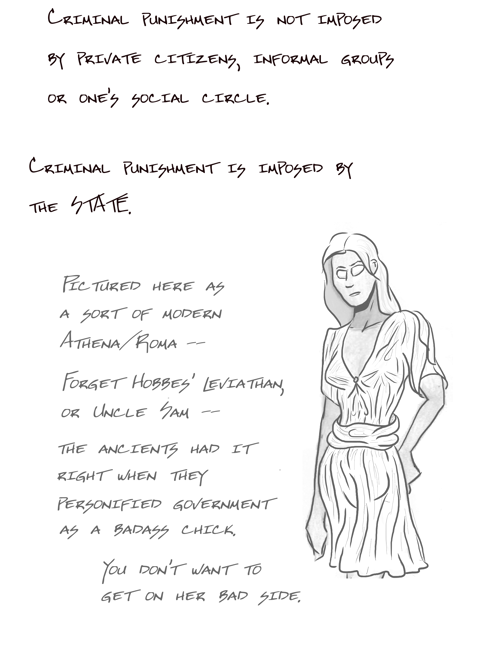
Nathaniel Burney offers an entertaining and non-traditional alternative. Using his own collection of anecdotal drawings, Burney started a web series of legal cartoons meant to explore concepts dealing with criminal law – then appropriately titled “The Criminal Lawyer’s Guide to Criminal Law”. Now, all 17 installments of his drawings are available  in “The Illustrated Guide to Criminal Law,” a beautifully drawn 260-page book that addresses everything from the legal definition of a crime to sentence enhancements for terrorism.

For your personal enjoyment, here’s a small taste of the Introduction:

Cheers to legal cartoons! The book can be purchased from Jones McClure Publishing.

Comments off

Job o’ the Day: The Simon Karas Fellowship in the Ohio Attorney General’s Office!

The Solicitor General/Appeals section of the Ohio Attorney General’s office is looking for new lawyers, recent graduates, or attorneys with limited experience to apply for the 2013 -2014 Simon Karas Fellowship! The Fellow works with the Ohio Attorney General’s Solicitor General, Deputy Solicitors, and other top lawyers in their office on Ohio’s major appellate cases, which often involve constitutional questions or hotly debated public policy concerns. Many of the cases are headed to the U.S. Supreme Court or are already there.

The office’s recent cases provide examples of the kind of work the Karas Fellow will accomplish. From the PSJD job listing:

  • Ohio has a busy practice in the U.S. Supreme Court. Our U.S. Supreme Court practice covers a wide variety of cases. In Bobby v. Dixon, for example, we successfully defended the constitutionality of a criminal interrogation under Miranda. In Levin v. Commerce Energy, the Court agreed with us that, under principles of comity and federalism, challenges to state tax laws must be filed in the state courts. We have also filed amicus briefs in a number of highprofile cases: Williams v. Illinois (admissibility of expert testimony about the results of DNA testing in criminal trials); Merck v. Reynolds (fraud claims under federal securities laws); and Doe v. Reed (First Amendment challenge to state law requiring public disclosure of ballot petitions).
  • In recent years, the Fellows have worked on other U.S. Supreme Court cases involving double jeopardy, school vouchers, free exercise of religion, federalism and state immunity, interstate commerce, and more.
  • The Karas Fellow also assists with cases in the Ohio Supreme Court, where we appear often, both as a party and as an amicus. To name only a few, our recent cases have involved the standard for imposing civil penalties under Ohio’s environmental enforcement laws, the constitutionality of Ohio’s Smoke Free Work Place Act, the eligibility requirements for seeking recovery for wrongful imprisonment, the constitutionality of Ohio’s bifurcation statute in civil trials involving punitive damages, the liability of mortgage servicers for fraudulent acts connected with the nationwide mortgage crisis, and the admissibility of physician apologies in medical malpractice cases. We are also defending the State against multi-million dollar lawsuits that allege state constitutional challenges to certain state taxes.
  • We also brief and argue many cases in the Sixth Circuit, and the Karas Fellow assists with those appeals as well. This past year, our Karas Fellow presented oral argument in the Sixth Circuit in a case concerning the constitutionality of a juvenile criminal sentence.

The deadline to apply is October 19, 2012. Check out the full listing, including qualifications and salary, on PSJD.org (log-in required).

Comments off