Job’o’th’Week (Entry-Level Edition)–EEOC Hiring Trial Attorneys in Many Places [CLOSES TOMORROW]

Help Wanted Photo: Brenda Gottsabend – CC License

The Equal Employment Opportunity Commission has many openings for Civil Rights Trial Attorneys with bar certification and at least one year of professional legal experience with litigation. (If you’ve done litigation in a clinic, ask your career advisor whether you can count that experience on your application.) If you’re interested, you’ll need to act fast. The deadline for applications is 11:59pm TOMORROW.

The job post on PSJD is here, but to since you’ll need to apply through USAJobs anyway here are the direct links:

Two vacancies in Las Vegas NV: https://my.usajobs.gov/GetJob/ViewDetails/388435700

Five vacancies in Phoenix AZ, St. Louis MO, Buffalo NY, and New York NY: https://my.usajobs.gov/GetJob/ViewDetails/388434900

Comments off

From die-ins to tangible change: how law schools and students are responding to Ferguson

Elizabeth Gyori
Program Assistant, Leitner Center for International Law and Justice at Fordham Law School

Law school communities protest police brutality in front of symbols of their legal expertise. [Reprinted with permission.]Law school communities protest police brutality in front of symbols of their legal expertise. [Reprinted with permission.]

Law students have lain in tense, reflective silence while holding signs that read, “Black Lives Matter.” They’ve chanted, “No justice. No peace. No racist police!” while blocking traffic. They’ve acted as legal observers, demanded inclusion at their schools, and called for long-term, systemic change. Many law schools have erupted in protest, activism and internal soul-searching after a grand jury declined to indict Darren Wilson, a white police officer, in the fatal shooting of Michael Brown, an unarmed African-American, in Ferguson, Missouri.

The Michael Brown case has become symbolic of rampant police brutality against communities of color in the United States and sparked an outpouring of anger and protests across the country. This movement against police abuse gained momentum after another grand jury declined to indict white police officer Daniel Pantaleo in the chokehold death of Eric Garner, an unarmed African-American, on Staten Island. Because many see these cases as failures of the criminal justice system, the voices of law schools, students, faculty and staff, who have spoken out against police abuse and institutionalized racism in light of recent events in a plethora of ways, are an especially significant part of this movement.

PROTESTS AND EVENTS
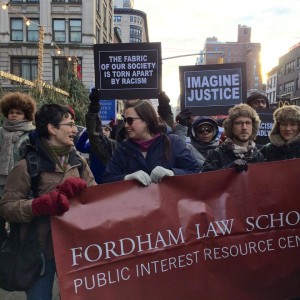
Fordham Law School contingent at Millions March in NYC, 13 Dec 2014 Fordham Law School contingent at Millions March in NYC, 13 Dec 2014 [Reprinted with permission.]

From Berkeley to New Haven, law students have organized protests in solidarity with national protests after the grand jury verdicts. Over 200 law students, faculty and staff participated in a die-in at UC Berkeley School of Law on December 10, in which about 40 people laid down in front of the law school for 15 and a half minutes. Eleven minutes symbolized the number of times Eric Garner gasped, “I can’t breathe,” while in a chokehold. Four and a half minutes symbolized the number of hours Michael Brown’s body was left in the street after he was shot dead. Similarly, over 500 members of Yale Law School led a die-in, lying in the street for four and a half minutes in New Haven on December 5.

Students, faculty and staff have also joined national and community protests for justice, both as representatives of their institutions or groups and as individuals. In New York, members of many law schools, including Brooklyn, Cardozo, Columbia, Fordham, New York and Touro, marched in the Millions March on December 13. In general, the recent protests have been noticeably youthful, and law students have been visibly present at the various actions.

As with most controversial legal issues, law schools have sought to foster dialogue about Ferguson and racial disparity in the US through forums and other events. Lewis and Clark Law School held two open forums on the shootings and grand jury verdicts. At The University of Washington School of Law, over 200 people attended a discussion led by Seattle Defense Attorney Jeffrey Robinson on Ferguson, policing in communities of color, and the criminal justice system. Many schools will host follow-up events in the spring on the issues Ferguson has brought to surface.

ORGANIZING AND ACTIVISM

Law schools and students are uniquely positioned to legally address the situation in Ferguson and surrounding issues. Recognizing this, student organizations like chapters of the Black Law Students Association (BLSA) and the National Lawyers Guild (NLG) have sprung into action. The National BLSA developed an activism toolkit on organizing strategies, possible campaigns and students’ rights when protesting.

Law students are “the ones who can affect change because it is the lawyers who will essentially change the law,” Kim Brimm, National Director of Public Relations for the NBLSA, said. “Some of us will become senators, and some of us will become governors, and councilmen, so it definitely starts with us.”

True to Ms. Brimm’s words, individual BLSA chapters have already started. In the wake of recent events, law students have begun working within their local communities to address police brutality and racial disparities. Harvard’s BLSA has been working with Professor Ronald Sullivan to draft model local cameras-on-cops legislation. The group also hosted a conference on police relations in Boston and Cambridge, which over 200 community members attended. The conference featured a “Know Your Rights” workshop and a dialogue with Boston and Cambridge police, which was “really, really powerful,” McKenzie Morris, president of Harvard’s BLSA, said.

In Philadelphia, University of Pennsylvania School of Law’s BLSA has been working with the American Civil Liberties Union on two projects on stop-and-frisk and civil access forfeiture. In partnership with the local organization Disproportionate Minority Contact, they also hope to launch a program next spring that will educate local law enforcement on adolescent psychology and facilitate dialogues between police officers and students in largely minority and disadvantaged schools, Dorian Simmons, President of UPenn’s BLSA, said.

Northwestern Law School's #handsupdontshoot solidarity action [Reprinted with permission.] Northwestern Law School’s #handsupdontshoot solidarity action [Reprinted with permission.]

Other law school communities have taken public stances on more national stages. To raise awareness and show solidarity, a wide array of student groups and some law school communities released statements condemning the non-indictments and calling for meaningful reform. A statement by members of Fordham Law School, which garnered over 350 signatures, expresses support for “thoughtful reforms such as demilitarization of our nation’s police forces and shifting the focus of enforcement away from tactics that have disparate racial impact.” An open letter to President Obama and Attorney General Holder, which was drafted by Harvard Law School’s BLSA, garnered over 1,000 signatures – almost half of the law school. The letter calls for action against a system that devalues black lives, including through the use of body-worn cameras by police, and the prosecution of police officers who have killed unarmed minorities.

Several schools and student groups have also engaged in media campaigns, including Northwestern, Harvard, UCLA, and Fordham law schools. They participated in the #handsupdontshoot campaign by taking photos in front of their law school signs with their hands raised. This fall, the Harvard’s BLSA even launched their own media campaign, featuring similar photos of students.

OBSERVATION AS ACTION

One of the most distinct ways that law students have engaged in recent actions is through legal observing, in which neutral individuals monitor and document the activities of demonstrators and their interactions with law enforcement at the request of organizers. When the Ferguson Legal Defense Committee (FLDC), an organization providing legal support to the Ferguson community, issued a call to action for law students, many responded by volunteering as legal observers, while others provided research support. Nicholas Klaus, a 3L at Wayne State University School of Law and Co-Student National Vice President of the NLG, made two trips to Ferguson in October and November, traveling with two fellow classmates in November. “I felt like I had a duty to go,” Klaus said. “I felt like there was a call to do something. I was in a position to do the work. It’s what I came to law school to do, and so, we went.”

Watching and documenting demonstrators’ interactions with police, Klaus observed (and experienced) police use of pepper spray, tear gas, and rubber bullets against protestors during his trips, which may prove important in defense of criminal charges brought against protestors and in affirmative litigation against such police practices.

With many student chapters of the NLG conducting observer trainings, legal observing by law students has also been prominent at community protests. Legal observing “allows people who would otherwise be pretty moderate to be a part of the movement without actually having to participate,” said Meredith Osborne, Co-Chair of University of Michigan Law School’s NLG chapter. “They can kind of be this ‘neutral observer,’ but in reality they know that they are there on behalf of the organizers.”

As protests continue, so does the need for observers. Osborne and her NLG chapter have been acting as legal observers for demonstrations in the Ann Arbor area since the summer and plan to conduct observer trainings every semester in light of an increase in interest from students.

CHANGES WITHIN

Nothing is more local for law students than their own law schools communities. Student coalitions at Georgetown, Columbia, and Harvard law schools have called on their own schools to become more inclusive of minority students and to address racism on campus. “As students of color on campus, we feel very isolated,” said a 2L African-American Coalition member at Georgetown who asked to remain anonymous. “The Coalition basically formed out of a feeling that we needed to do more, and get the university to really listen to what our needs are and what our problems are with the way the people of color are treated on campus.”

Generally, each coalition is demanding institutional support for students affected by recent events, a public statement by their respective administrations on Ferguson, exam extensions on an individual basis, and continuing initiatives to address diversity on campus, including diversity training. Schools have begun to respond to these demands, with all three schools beginning dialogues with the coalitions and Columbia Law School granting exam extensions.

In this time of reflection, some law schools have implemented or are considering new programs addressing diversity and racial disparity in the justice system. For example, Columbia Law School launched an online forum on police accountability, complete with fact sheets on the Michael Brown and Eric Garner cases written by faculty, for interested students who want more information for informed conversations with family and friends. The school is also considering small group discussions on the issues surrounding Ferguson and a parallel orientation or year-long program for 1Ls on how race, gender, poverty and social exclusion intersect with the law, said Ellen Chapnick, Dean for Social Justice Initiatives at Columbia Law School.

MOVING FORWARD

Activism around and the police killings of Michael Brown and Eric Garner has opened a space for public conversations addressing police brutality, racism and failures of the justice system in the US. Law school communities are seizing this moment of opportunity to explore innovative and creative ways to frame these dialogues and push for justice in Ferguson and beyond.

Comments off

You Need a Montage: Social Networking Scene

Okay, grasshoppers. Welcome to the fourth week of our holiday job search training montage. So far, we’ve revamped our resumes, reconsidered our cover letters, and mastered the process of arranging informational meetings, step by step by step. If you’ve kept pace, you’re probably pretty exhausted (especially if you’ve been dealing with final exams and papers as well). The good news is that at this point, the worst is behind you. This week, we have just a few more holiday job search tips to unpack before we’re ready to make the most of our winter vacation.

Today, we’re going to look at holiday job search tips #2 and #3 together: crafting a pitch and networking at holiday parties. It’s likely that you’ve already begun to receive invitations to various holiday parties—if you haven’t already attended a few. These mixers are a great way to interact with people in a more informal way. The part I often struggle with, though, is communicating on issues I deeply care about without bringing an inappropriately serious atmosphere to the party. After a conversation with Christina, though, I have a new strategy for mixing business with pleasure—and a well-crafted “pitch” is part of it.

Working on Your Pitch

There is a wealth of advice out there for creating a good “pitch” or “elevator speech.” Basically, it’s a clear, concise, memorable and appealing statement of (1) who you are and (2) what you do. Many sources (see, e.g., Above the Law) think you’re likely to get 30 seconds to capture your conversation partner’s attention. Christina thinks you’re better off aiming for only 10 or 15. Regardless of how long you decide to make it, the key is to practice it—try it out on classmates, colleagues, and career advisors. (You can also visit your career advisor if you’re having trouble coming up with one in the first place.)

Delivering Your Pitch

A note for those who don’t like barging into conversations: I hate walking into conversations cold, but sometimes you don’t really have a choice. If you find yourself running solo at a networking event, try to set a small, realistic goal for yourself, something like, “I will talk to two people before I leave,” or “I will stay for 40 minutes.” You may also want to break the ice by starting with someone else you notice hanging around the edges, unsure of how to open.

  1. GETTING IN: Know your audience. Many of us reach for legal jargon because our work is complicated, and therefore difficult to describe succinctly and clearly without specialized language. If you’re speaking to someone without a legal background, impress them with clarity, not sophistication. For example:

    Conversation w/Legal Background

    Conversation w/o Legal Background

    “This summer, I’ve been surveying state court cases concerning tent cities, looking for homeless litigants’ novel arguments.” “I’ve been looking for new ways for homeless people who live in tent communities to protect their interests in court.”

    If you’re at a law-related event, or someone steers you toward a stranger with the introduction, “So-and-so’s a lawyer too!” (this happens), you at least know that the person you’re speaking with shares some kind of background with you. But you still might have to tailor your introduction further. For example, I was at a networking event during my 1L summer and a lawyer from a firm asked me what I was doing with my summer.  I told her, “I’m working for an organization that represents political prisoners in front of international tribunals.” Her response: “Oh, so you represent terrorists?” Our exchange never recovered. I should have front-loaded more information about how we vetted our potential clients. Whenever you can, try and find out about the person you’re speaking with before you open. You can ask the person who introduced you for more information, or simply start your conversation with a question.

  2. GETTING THROUGH: Keep it short throughout the conversation. This is often where I fall down. When people ask me what issue is most important to me (water affordability, by the way), I have a 20-30 second speech explaining why all prepared for them. But it’s a crazy issue that almost always leads my conversation partner to ask a follow-up question. The hardest thing (at least for me) is not to take a person’s interest in my work and run with it as far as I can. I want people to understand my issue, and I want to go into depth with them. Keeping responses short is hard, but it ensures you don’t go so far into a topic that your partner feels trapped or bored.
  3. GETTING OUT: Remember, there was a point to starting this exchange. You’re there to figure out if you want to make this person a part of your network. You should focus on this next step in the process, not on any end goal. (In other words, don’t turn social events into informational meetings). There are three ways these exchanges may go:
    1. If you’re enjoying the conversation on a professional level, ask if you could get their contact info so you can follow up with an informational meeting later.
    2. If the conversation isn’t going anywhere for you, make a graceful exit (not difficult if your conversation partner is also sticking to short, clear responses). Something like, “thanks, I really enjoyed speaking to you, but I should really [hit the buffet/find my friend/etc]. Let me know if there’s anything I can do for you in the future.” should do the trick.
    3. If you’re enjoying the conversation on a personal level and you’re still reading, switch to a different advice column.

Alright, everybody. See you Friday for the final installment. Until then…

Wax on, wax off,
-Sam

Comments off

Class of 2015 Skadden Fellows from some familiar places.

The Skadden Foundation has announced its Class of 2015 Fellows.  Twenty-eight Fellows, hailing from 16 law schools will begin their projects next year.  Five schools had multiple fellowship awardees; Harvard (6); NYU (2); Stanford (2); Yale (4); and U Penn (3).  Fellows come from the other following schools:  Michigan State, Vanderbilt, University of Chicago, Chicago-Kent, Georgetown, Columbia, UC Irvine, Villanova, Loyola (LA), American University, and Suffolk.  The Fellows will work in 11 states, focusing on issues ranging from the wrongful denial of Medicaid claims for poor, disabled children in Texas to the barriers to housing, employment and education for low-income LGBTQ youth with criminal records in Illinois.

For comparison’s sake, here’s how previous Skadden Fellowship classes have looked:

  • 2014:  28 Fellows from 16 law schools;
  • 2013:  28 Fellows from 16 law schools;
  • 2012: 28 Fellows from 16 law schools;
  • 2011:  29 Fellows from 21 law schools;
  • 2010:  27 Fellows from 20 law schools;
  • 2009:  28 Fellows from 14 law schools.

Congratulations to the Class of 2015!  We look forward to the amazing work you will do!

Comments off

You Need A Montage: Informational Meetings Scene III (Following Through and Following Up)

Sam Halpert, PSJD Fellow 2014 – 2015
Christina Jackson, Director of Public Interest Initiatives and Fellowships
(with thanks to the professional development teams at UC Berkeley, Washington and Lee, and Seattle University Law Schools)

Okay, grasshoppers. Last month, I confessed my job search skills are weak and committed to questing with you to learn from PSJD’s resident career development guru Christina Jackson. Since then, we’ve re-made our resumes and cover letters. This week, we’ve begun the real work, for to master the art of informational meetings we must remake ourselves.

Creating a Strategy for Informational Meetings (Tip 5)

It’s been a busy week, on Monday, we covered the first step in our strategy—identifying contacts. Wednesday, we talked about reaching out to request a meeting. If you haven’t worked through those posts already, go back and make sure you’re up to speed before starting on this one.

Ready? Okay. You’ve identified your network of meeting candidates and you’ve made your initial contacts. Now, we need to talk about what it takes to get good insights from a meeting, make a successful connection with the person you speak with, and make that connection stick. (I’ve done many informational meetings, but I haven’t had the benefit of trying it with a game plan like this, so I don’t have examples for you. We’ll just have to go through this process together.) After reading this post, you should be able to prepare a strategy for the informational meetings you’re planning with your contacts and for following up with those contacts after your meeting happens.

NB: Don’t forget to check out the Google Drive spreadsheet tool I’m using to organize my own informational meeting efforts. I’m planning to log meetings in the “Log Interactions” sheet. The final sheet, “Long-Time, No-See” is to help me keep track of when I need to follow up with my contacts.

Part III: Following Through and Following Up

  1. HOW TO PREPARE:
    1. More research! Your contacts don’t want to tell you things you could have learned from their website. Although you looked into your contact’s background before reaching out, you’ll need to be even more prepared when the two of you speak. Once a person agrees to meet with you, begin by refreshing your research on that person and that person’s organization. Also include any relevant information you may have learned during other informational meetings–are other people in your network connected to the person you plan to interview.  This research is helpful because it will ensure that you’re able to…
    2. Plan specific questions. Your contact will expect you to set the agenda and use his or her time effectively. You have the primary burden to keep the conversation going. Make sure you know what information you’re hoping to learn so you can ask appropriate questions. (Christina and her network of career development professionals have prepared a list of sample questions for us to tailor to specific circumstances.) Good research should make the conversation easier to direct and control, but allow for the possibility of a surprise. You should be ready to go off-book if you hear something interesting and unexpected.
  2. HOW TO FOLLOW THROUGH:
    1. Follow job interview etiquette. Arrive 5-10 minutes early, wear business attire, and turn off your cell phone.
    2. Act like an interviewer. Remember, an informational meeting is like a job interview in reverse. That means that you get to be the one who shows up with research notes, and the one who takes notes during the meeting.
    3. Keep the focus (mostly) on your contact. Again, in this situation you’re the interviewer. The meeting should be directed by your information needs, but the subject should be your contact and the work he or she does. Still, your contact will implicitly understand that you would probably be open to positions he or she knows of, so be sure to introduce yourself and your credentials in a way that leaves the contact with a good memory of you. You should also always bring a copy of your resume, but don’t hand it over unless your contact asks, or unless you think their experience could help you improve the document.
    4. Be aware of time. Don’t take more time than you asked for, unless the contact expressly offers to let the conversation run over. Also, make the most of your time–stay engaged and professional even if you determine before the interview is over that the field you’re discussing isn’t for you.
    5. Network. Your last question should always ask whom you might speak with to learn more.
  3. HOW TO FOLLOW UP:
    1. SAME DAY/NEXT DAY: Write (thank you) notes for them, and (regular) notes for yourself. Send a thank you note (letter or email) to your contact, and also to anyone else who helped you set up the meeting. Also take the time to analyze your meetings. Reevaluate your interest in the career you discussed, based on what you learned. (Your career development office can help you make sense of your thoughts at this point.)
    2. NEAR FUTURE: Follow up on leads you received from the meeting–reach out to any contacts the person suggested and check out any resources the person mentioned.
    3. ONGOING: Keep contacts apprised of your career development activities. This is the part that most unsettles me. I’m terrible at keeping in touch with people. But, ideally, the people I’ve been meeting with are going to become my colleagues. Making a good impression is only significant if it’s also a lasting one. This is where the spreadsheet tool will hopefully keep me on track. I’m not certain exactly how frequently I want to check in with people (Christina says that within reason it’s a matter of personal preference), so the tool will let me set an interval of months and show me which contacts haven’t heard from me in awhile.

That’s all I have for now. With the pace of this series, I haven’t been able to run ahead this time and try out a meeting for you all before writing this post. So good luck to you as we all leap into this together.

Wax on, wax off,
-Sam

Comments off

PSJD Public Interest News Digest – December 12, 2014

by Christina Jackson, NALP Director of Public Service Initiatives & Fellowships

Happy Friday!  We continue our series on job search strategies for the winter break on the PSJD Blog.  Check it out and share with your friends.

Here are the week’s headlines:

  • LGBT law clinic Legal G launches in FL;
  • Santa Ynez Band of Chumash Indians donates funds to help homeless;
  • Iowa Legal Aid champions attorney fee for the poor;
  • Spotlight on Public Service Servants: Ellen Greenlee;
  • Super Music Bonus!

The summaries:

December 6, 2014 -Tavernier lawyers Bernadette Restivo, Elena Vigil-Farinas and Jessica Reilly have launched Legal G-Aid, a nonprofit aimed at helping low-income people with LGBT-related legal issues. “It registered with the state Nov. 4 — Election Day — and officially launched at a kickoff event Friday in Key West.” “The basis for the nonprofit, according to Restivo, is the costs associated with LGBT-related legal issues.”  “Restivo is seeking the help of others to serve on Legal G-Aid’s board and attorneys who are willing to work pro bono or at a “greatly reduced” hourly rate to help with LGBT legal issues. She said she has interest from people in other counties in starting their own Legal G-Aid chapters.”(KeysInfoNet)

December 8, 2014 – “To bolster the Legal Aid Foundation of Santa Barbara County’s efforts to reduce homelessness through its effective programs, the Santa Ynez Band of Chumash Indians donated $10,000 on Monday to the organization’s fundraising campaign.  The Legal Aid Foundation’s vision is to provide equal access to justice for all; removing victims of domestic violence permanently from harm’s way, preventing homelessness, helping seniors live with dignity and independence, and providing a legal safety net for low-income residents of Santa Barbara County.”  (NoozHawk)

December 10, 2014 – Iowa Legal Aid has championed a proposal to require most Iowa attorneys to pay a yearly $100 fee to support its budget.  “The proposal has divided Iowa lawyers and has brought in more than 130 pages worth of public comments to the state Supreme Court. Lines are drawn between attorneys who believe they have a special duty to help the poor get access to courtrooms and those who argue a mandatory fee is essentially forced charity or an unfair tax on lawyers.”  “A $100 mandatory fee could potentially raise $903,400 of an estimated $1.8 million needed to boost the number of staff attorneys, according to the report from Supreme Court staff. Currently, eight other states require attorneys to pay similar fees, including Illinois, Minnesota, Missouri and Wisconsin. The Iowa high court is also considering whether the fee could be paid on a voluntary basis.”  Comments will be accepted until January 5, 2015.  (The Des Moines Register)

Spotlight on Outstanding Public Servants: “Ellen Greenlee, who has been the chief defender at the Defender Association of Philadelphia for the past 25 years, has announced she will be stepping down this spring.  According to a statement from the association’s board of directors emailed Tuesday, Greenlee will be retiring as the chief public defender March 1, 2015. Greenlee has worked at the association for 40 years, and spent 25 as chief defender, the statement said.”  “Her exemplary career has truly been a light in all-too-often dark corners of the criminal justice system and we join in celebrating her accomplishments and well-earned retirement,” said David Rudovsky, president of the association’s board of directors, in the statement. “On behalf of the board, and we know we speak for many in the Philadelphia criminal justice community, we express our deepest thanks to Ellen for her extraordinary leadership and service of the Defender Association.”  We congratulate Ms. Greenlee on an outstanding career, and thank you for your service.  (The Legal Intelligencer)

Super Music Bonus! http://youtu.be/4vNcGlM8O3I

Comments off

Job’o’th’Week (Entry-Level Edition)–Legal Division for the US Court of Appeals, DC Circuit

Help Wanted Photo: Brenda Gottsabend – CC License

The US Court of Appeals is seeking “highly qualified” attorneys to join the Legal Division of its Office of the Clerk for a permanent, full-time appointment (after a one year probationary period). However, the position qualifications indicate that “highly qualified” individuals may include recent grads with impressive student resumes.

Interested? Check out the complete job post on PSJD. The application has a rolling deadline.

Comments off

Job’o’th’Week (Experienced Edition) — Civil Legal Aid with NYC-based Holistic Public Defense Practice.

Help Wanted Photo: Brenda Gottsabend – CC License

According to its mission statement, the Neighborhood Defender Service of Harlem is a “holistic public defense practice.” Among other things, this means that “when [their] clients face collateral consequences with their employment, school, or in family, housing or in immigration court, NDS strives to help our clients solve those issues.” According to their recent job post on PSJD, this civil aspect of NDS’ practice is growing. (No wonder: according to National Inventory of the Collateral Consequences of Conviction, there are over 1200 potential collateral consequences in New York State.)

In order to protect their clients from these civil consequences of criminal convictions and criminal accusations, NDS is looking for a supervising attorney for their civil team.  They need someone with managerial experience who’s spend at least five years representing clients or supervising representations in civil legal proceedings, with at least three years working with housing and/or benefits law in particular.

Interested? Check out NDS’ complete post on PSJD. (Application deadline December 31.)

Comments off

You Need A Montage: Informational Meetings Scene II (Making Contact)

Sam Halpert, PSJD Fellow 2014 – 2015
Christina Jackson, Director of Public Interest Initiatives and Fellowships
(with thanks to the professional development teams at UC Berkeley, Washington and Lee, and Seattle University Law Schools)

Okay, grasshoppers. Last month, I confessed my job search skills are weak and committed to questing with you to learn from PSJD’s resident career development guru Christina Jackson. Since then, we’ve re-made our resumes and cover letters. This week, we’ve begun the real work, for to master the art of informational meetings we must remake ourselves.

Creating a Strategy for Informational Meetings (Tip 5)

On Monday, I wrote about the first step in our strategy—identifying contacts. If you haven’t worked through that blog post already, go back and make sure you’re up to speed before starting on this one.

Ready? Okay. Today, we’re focusing on crafting our initial meeting requests. After reading this post, you should be able to draft a few emails making initial contact with the people on your list (see part one) that you decided you should reach out to first.

NB: Don’t forget to check out the Google Drive spreadsheet tool I’m using to organize my own informational meeting efforts. For contacts I’ve already spoken with, I started by recording our most recent exchange (email, etc.) in the “Log Interactions” sheet. I also used this sheet to log the new emails I sent today during this exercise.

Part II: Making Contact

Send an email or (if time permits) write a cover letter. (You can call, but if you do be prepared to have your meeting on the spot if a person answers the phone and expresses willingness to speak with you right there and then.)

This week, I worked up several emails for a few of my first-run candidates, including both people I know and people I don’t. (To avoid calling possibly-unwanted attention to my contacts, I’m not sharing these messages in their entireties.) As with job applications, you’ll want your emails to be well-written and to demonstrate your background research. Still, keep in mind that the stakes here are lower than with communications related to job applications: People are usually much happier to receive requests for information and advice than requests for a job, and answering questions is less intense than evaluating candidates for a position. You shouldn’t have to work quite as hard to land an informational meeting as you will for a job interview. (My informational meeting requests all took between 100 and 200 words.)

    1. WHAT TO SAY: When you contact a person to ask for an informational interview, your messages should establish three things:
      1. Who you are. Once the person can picture who you are, they can start to imagine what sort of advice you might need. You’ll always want to briefly explain your background. (E.g., “I’m a recent graduate from Georgetown University Law Center with a background in economic justice and human rights.”) (Editor’s Note: We’re going to discuss the art of boiling your life down to a sentence or two later this month, when we cover how to rehearse your “pitch.”) One thing I’m trying right now (I don’t know if it will help) is including a link to my LinkedIn profile in the postscript; I’ve learned that some people check me out there any way before our meetings. (E.g. “I didn’t want to throw a resume at you, but if you’re curious you can find me at [link].”)
      2. Who they are (to you). Busy people are more likely to arrange an informational meeting with you if they can tell you’ve chosen whom to contact carefully. An easy way to establish your familiarity is to mention any professional connections you might already have. If you got the person’s name from someone else, be sure to mention the name of the person who referred you.  (E.g., “Christina Jackson at NALP mentioned you might be a good person for me to speak with.”) If you took a professor’s class, remind her of that fact. (E.g., “I was in your comparative rights seminar in 2012.”) Even if you don’t have an existing link, you can always try to connect with a person’s work. (E.g., “I’ve been particularly inspired reading about your organization’s Community Development Project and its Safety Net Project.”)
      3. How their work relates to your goals. You may also want to tell recipients why you believe they would be good for you to speak with. You don’t have to write out a list of questions you plan on asking, but it helps to give people an idea of where the conversation might go. It’ll help them figure out if they have meaningful advice or insights to share with you. (E.g., “I’m interested in the path you took to Pro Bono Net and how your previous experiences with New York legal aid organizations inform your current work.”)
    2. WHAT NOT TO SAY: Make it clear you’re not asking about a job or for a job. You don’t have to say this explicitly. (I generally don’t.) Just make sure there’s no doubt.
    3. WHAT TO ASK FOR:Be specific about how much time you’d like each person to give you, and try not to ask for more than fifteen (or twenty) minutes. Ideally, you want to meet in person. However, make it clear that you’re available to speak over the phone if an in-person meeting isn’t possible. Keeping with our holiday job search theme, you’ll probably find yourself letting people know when you’re in town for the break, proposing that they tell you whether they have time for you on any of those days.
    4. WHAT TO DO NEXT:Be ready to go the distance. Don’t write to someone if you can’t commit to doing everything you can to get an interview. This means you have to make a follow-up call if you don’t hear back. Many of the attorneys you contact are very busy; in many cases, if you email but then never call to follow up, you may as well not have bothered writing in the first place. Follow up with a call about a week or ten days after you send the email or cover letter. If you reach your contact, you’ll want to be prepared with a spoken version of your email: introduce yourself, confirm your email got through, ask for a meeting (no more than 20 minutes), and stress that you’re willing to meet at a time and place convenient for that person.As before, don’t call until you’re prepared for the meeting itself—your contact may ask you to do the informational meeting on the spot after picking up the phone.
    5. DEALING WITH REJECTION: If you get turned down, always politely thank each person for his or her time. If you still have the confidence, think about asking whether the contact might recommend someone else they think would be useful for you to meet with. If you don’t hear anything after emailing and calling to follow up, use your judgment. Typically, the third email or call is the limit; if you still don’t hear back you need to move on. It’s useful to keep track of each email and call and to note their results (this is where the spreadsheet tool comes in).


I hope this advice helps you get your first few meeting requests out to your contacts. I’m aware this week’s posts are less soul-baring than previous ones in this series, though. If anyone of you feel we’re missing out by not posting a clear example, please write and let us know. I’ll look harder for a solution.

Wax on, wax off,

-Sam

Comments off

You Need a Montage: Informational Meetings Scene I (Identifying Candidates)

Sam Halpert, PSJD Fellow 2014 – 2015
Christina Jackson, Director of Public Interest Initiatives and Fellowships
(with thanks to the professional development teams at UC Berkeley, Washington and Lee, and Seattle University Law Schools)

Okay, grasshoppers. Last month, I confessed my job search skills are weak and committed to questing with you to learn from PSJD’s resident career development guru Christina Jackson. Since then, we’ve re-made our resumes and cover letters. But now, the real work begins, for to master the art of informational meetings we must remake ourselves.

Creating a Strategy for Informational Meetings (Tip 5)

The goal of an informational meeting is twofold: First, it allows you to gather information and advice. Second, it helps you develop professional relationships. A master of these meetings has power far beyond one who can research and write application documents quickly and with confidence.

Resumes and cover letters are documents you send out during your job search. Planning for and following through with informational meetings involves putting your self out there, all the time. Although these meetings aren’t job interviews, how you present yourself and your credentials matters. They may reveal otherwise hidden opportunities. At PSJD, we do our best publicize positions, but often job opening info travels by word of mouth. Attorneys upon whom you make a good impression will remember you when they have openings or even recommend you to friends for positions for which they believe you’re qualified. Also, these meetings aren’t just for the beginning of your job search. While extremely helpful for beginners, they’re critical at later stages as well, helping to narrow practice areas or geographic locations—even to choose particular offices. This means you’ll always want to be reaching out to other lawyers and maintaining contact with practitioners already in your network, whether or not you’re looking for work.

If this idea sounds daunting, I agree. Christina’s ramping us into this task over three posts.  First, we have to learn how to identify candidates for these meetings and how to decide whom to contact first. Next, we’ll practice crafting our initial meeting requests. At the end of the week, we’ll discuss how to follow through with a meeting and follow up on one. After reading this post, you should be able to create a list of candidates for informational meetings and decide to which people you’ll reach out first.

NB: I’ve created a little spreadsheet tool in Google Drive to help myself. I’m sure there are more sophisticated programs out there, but this one was easy to make, and makes sense to me based on Christina’s advice. If it helps you, feel free to download it for yourself. What we discuss today involves filling in the first sheet of the tool (“Add/Edit Contacts”). (I marked down which people I wanted to contact in the first group (and so on) in the “Notes” section of the sheet.)

Part I: Identifying Candidates

Informational meetings are like job interviews in reverse. You initiate the contact, and you ask the questions. People who enjoy their work are happy to talk about what they do and are usually willing to help. In return, though, you must be prepared to use their time effectively. As a first step, this means you need to make sure you’re reaching out to the right people.

  1. Set parameters for your search. Contacting people takes time and energy; you need to focus your efforts. (Also, when you begin meeting with people, they’ll want to know why you were interested in talking to them in particular.) To begin developing a list of candidates for your informational interviews, you should first identify your areas of interest. Think about classes you’ve enjoyed, areas of practice you thought about before law school, or things that simply sound cool. Talk to classmates, read professional articles, and attend extracurricular events, noting what piques your interest. (The PSJD Resource Center’s “Practice Area Guides”—as well as your friendly neighborhood Career Office—are also a good place to start.)

    Next, limit your geographic preferences. It’s both prudent to use these meetings to connect to the legal market in areas where you’d like to practice and impractical to talk to practitioners in many different locations. Get a particular perspective on one or perhaps two geographic regions where you’d like to set your law career. (Remember, for the holidays it may be most efficient to focus on the geographic area where you’ll be spending winter break.)

    After some brainstorming, my list included 4 categories and 2 geographic regions. In general, my areas of interest were pretty broad for someone who’s already graduated. But, Christina noted that the breadth of your list can often depend on what you’re choosing to focus on. For example, if your interest is criminal defense, you’re aiming for a tightly-bound world of work. My interest (Economic, Social and Cultural Rights) doesn’t have an official place in the US legal pantheon. As a result, I’m still searching through several different fields that touch on ESC rights. Bottom line: your list will look different depending on where you are in your career and what you’re hoping to do. But always ask yourself whether you could be more focused in your search, and whether you’re ready to articulate your career goals more clearly.

  2. List the people you know best and work outward. Make a list of people you already know that have or might have connections to your areas of interest within your geographic range. Don’t just look for people with your “dream job”; also find people with information or experience that might help you clarify your job search or achieve your intermediate goals. Start with your professional and social groups, including:
    • Classmates & Alumni (Law school & undergrad)
    • Law School Faculty and Staff
    • Family (nuclear & extended)
    • Friends & Neighbors
    • Colleagues & Supervisors (present & former)
    • Volunteer organizations
    • Religious groups
    • Professional contacts (from conferences, CLEs, etc.)

    Once you’ve worked through these possibilities, if your list feels thin in certain areas then think about who you might want to cold call, looking at names from:

    • Local trade & professional associations (i.e. your local state bar association)
    • Trade magazines and journals
    • Newspapers
    • CLE faculty rosters

    I’ve had a variety of legal work experiences, so I was able to come up with a decent list drawing mostly from people I know directly. My list wasn’t complete, though. According to Christina, your initial list should always include: (1) supervisors from all your legal jobs, (2) all professors you studied your areas of interest with, and (3) all classmates (law and undergrad) doing work in your areas of interest. I had to backtrack and add professors I hadn’t developed close relationships with, as well as classmates with whom I haven’t spoken in a while.

  3. Set contact priorities. Start with the people you know best, and to whom you feel safest reaching out. In particular, your Career Development Office is probably sitting on a wealth of contacts and has the expertise to help you figure out who your best bets are. Another advantage of your CDO is that you know you aren’t imposing on them for help—helping you with this stuff is their job. Personally, I worry hugely about bothering busy people. Christina stressed how important it is not to worry about imposing on your contacts, especially in this early stage of planning:

    “If people don’t want to be bothered, they just won’t write back. If they do write back, they’ve made a conscious decision to help. Take them up on it. You may not feel as though you have anything to offer them, but most people probably received help themselves at some point; they want to pay the favors they received forward.”

I can’t think of better words to leave you with than those. Good luck building your lists; we’ll talk about what to do with them on Wednesday. Until then…

Wax on, wax off,
-Sam

Comments off